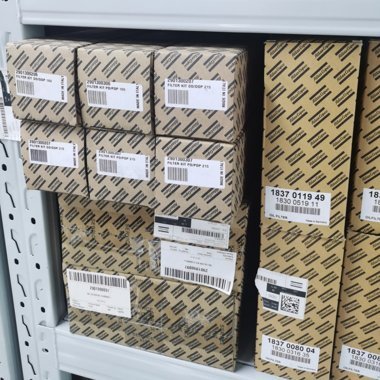
Planned maintenance is the cheapest thing you can do for a GA screw compressor. A genuine service kitbundles the consumables your machine needs at each service into one part number — so nothing gets missed. Here’s what’s in a kit, when to change it, and how to pick the right one for your GA model.
Start with the schedule for the exact machine
Do not select a kit from a generic hours table. Read the controller service message and the maintenance schedule for the exact model and serial range. The required scope can change with lubricant, ambient conditions, duty cycle, machine revision and the service program in force at your site.
- Identify the intervention: routine filter service, separator service, oil change, valve overhaul or another scheduled event.
- Record both time and hours: the applicable instruction may use running hours, elapsed time or whichever limit is reached first.
- Check outstanding alarms: a service reminder is not a diagnosis of every active fault.
What a GA service kit may contain
Atlas Copco describes service kits as intervention-specific groups of parts under one ordering number. The contents therefore depend on the kit, not on a universal list. Common examples include:
- Air filter element — protects the compression element from intake dust.
- Oil filter — keeps the circulating oil clean.
- Oil separator — removes oil from the compressed air (on major-service kits).
- Lubricant-related items — oil may be specified for the intervention but supplied under a separate ordering number.
- O-rings and seals — so everything reseals correctly.
Match the kit to the model, serial and intervention
A kit for one GA configuration should not be assumed to fit another. Start with the kit number when it is known. If it is unknown, send the exact GA designation, serial number, controller service message and the maintenance task you intend to perform. Ask the supplier to state the current kit number and contents on the quotation.
Account for site conditions before the interval expires
Dust, heat, humidity, frequent starts and heavy running can change how parts age. Trend intake restriction, temperature, pressure drop and oil condition where the machine supports those measurements. If readings move abnormally, investigate the cause instead of simply resetting the service timer.
Checklist before the planned maintenance stop
- Verify the kit label and contents against the quote and packing list.
- Confirm whether oil, cleaner, drain parts or special tools are separate.
- Prepare safe isolation, depressurization and competent service personnel.
- Record controller readings and current alarms before work begins.
- Keep removed labels and note the installed date and operating hours.
Why an intervention-specific kit is useful
A correctly selected kit reduces separate purchase lines and the risk of discovering a missing seal after shutdown. It also gives the maintenance team one traceable kit number. This benefit only applies when the kit has been matched to the correct machine and intervention; the box itself is not a substitute for checking the schedule.